Is AI What You Really Need?
AI projects are not the solution to all your firm's problems, and if not planned correctly, they might be just another one topping them all. In the article below, I will show how a manager should consider at least 3 possibilities before committing to an AI project.
Lior Zelering
5/8/20248 min read


Is AI What You Really Need?
“Let's AI this thing!” You might hear this cry running through your workplace offices as technologists, operational managers, and CEOs high-five uncontrollably. But instead of a declaration, it should be a question: “Let’s AI this thing?” AI projects are not the solution to all your firm's problems, and if not planned correctly, they might be just another one topping them all. In the article below, I will show how a manager should consider at least 3 possibilities before committing to an AI project.
The three methods
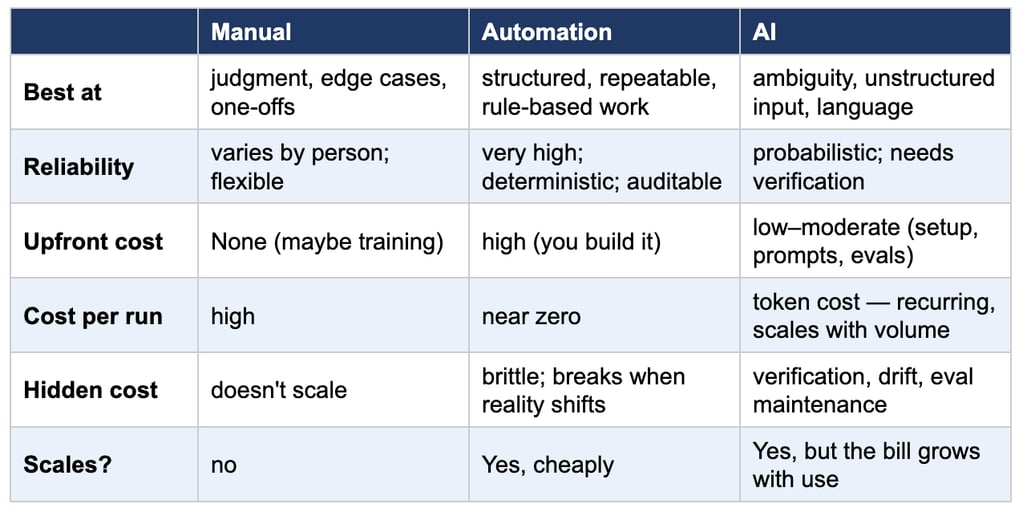
The three differ less in what they can do than in their cost structures and reliability, and each handles a different kind of work.
Manual work is performed by people. It needs no specification and no build: you simply do it. People are unmatched in judgment, edge cases, and anything rare, because they handle situations no one anticipated. The cost is purely marginal; it accrues per task and scales linearly with volume, which is also its limitation. Manual work does not scale because the thousandth unit costs roughly as much as the first. People, if we still remember these guys, are powerful machines with built-in neural networks; they can actually learn and do many tasks, not just one, and don't run out of tokens and rarely break down.
Deterministic automation is rules, scripts, and workflow engines, and robotic process automation is the most underrated of the three. It inverts the cost structure of manual work: a substantial fixed cost to build and maintain, after which the marginal cost per execution is near zero. It is exact, repeatable, auditable, and fast; for structured, high-volume work, it is unbeatable in both cost and reliability. Its weakness is brittleness: it handles only the cases its author anticipated and breaks when inputs deviate from its assumptions. A large share of proposed "AI projects" are automation problems in disguise, where the inputs are structured, and the rules are stable, and a model would only add cost and uncertainty. One reason we overlook automation is that it has been around for decades, making us forget how it all started. However, AI hasn't killed automation; automation amplifies AI's weaknesses.
Probabilistic AI earns its place on the work the other two cannot touch: ambiguity, unstructured input, and language, handled without exhaustive rules. The price of that flexibility is that its output is non-deterministically correct with some probability rather than by construction, and that single property reshapes its cost in ways most estimates miss.
What each truly costs
Before an ROI can be assessed, each investment must be sized honestly. Let V be the number of task instances over the planning horizon. The total cost of ownership of each method is then:
Manual: TCO = c_h · V
Automation: TCO = F_a + m_a · V
AI: TCO = F_AI + m_AI · V
Manual cost is linear in volume; c_h is the fully loaded cost of one human-handled task. Automation carries a fixed build cost F_a amortized over the horizon and a marginal cost m_a that is effectively zero. The two cross at a break-even volume
V* = F_a / (c_h − m_a)
Below which manual work is cheaper, and above which, provided the task is structured enough to encode as rules, automation wins. That single comparison already settles a great many cases without AI entering the conversation at all.
The AI term is where estimates go wrong, because the marginal cost of an AI task is not the token price. It is
m_AI = t + r·c_v + p·c_e
where t is the token and compute cost per task, r is the share of outputs needing human verification, and c_v is the cost of verifying one, and p is the probability of an error that survives review, with c_e its expected cost. Teams price AI at t alone. That is a first-order mistake: the verification term r·c_v typically exceeds the token term by an order of magnitude, and the residual-error term p·c_e often decides whether the use case is admissible at all. AI is cheap per token and frequently not cheap per trusted output, because trust in a non-deterministic system must be bought through verification, and verification is recurring labor.
This is an old result. In "Ironies of Automation" (Bainbridge, 1983), Lisanne Bainbridge showed that automating the routine part of a task does not remove the human; it reassigns the human to monitoring and intervention, work harder than what was automated away. The verification term above is that irony in dollars.
Invoice processing makes the contrast concrete. Reading totals from structured PDFs is high-volume and rule-based: automation displaces the manual cost almost entirely and never requires its arithmetic to be checked. Route the same task through a model, and you add a token bill and a standing obligation to verify outputs that are usually, but not always, right. As a cost play, AI here is the most expensive way to do work that automation does better.
Working the numbers: a document review
We can put those simple formulas into action, even though they don’t account for all the hidden costs of any project. A compliance team must review 20,000 account-opening documents a year to confirm each contains a required risk disclosure, a yes/no check. A disclosure that slips through unflagged creates regulatory exposure, so errors are not free. There are three ways to do the work, and the arithmetic decides between them. (The figures below are illustrative but ordinary for this kind of task.)
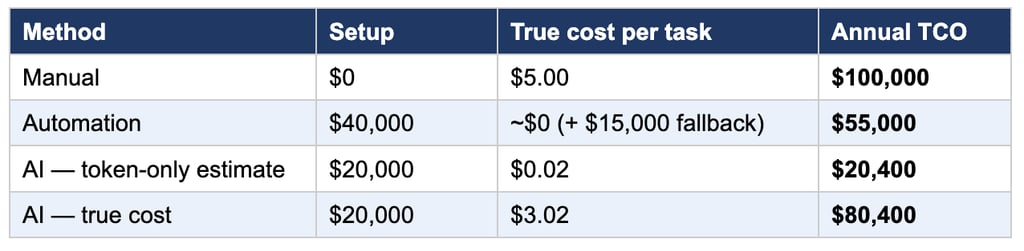
Manual. A reviewer clears a document in about six minutes; at a fully loaded $50 an hour, that is c_h = $5 per document.
TCO_manual = c_h · V = $5 × 20,000 = $100,000 / year
Automation. A rules-and-text-matching system costs roughly $40,000 to build and maintain in the first year (F_a), after which the compute per run is negligible (m_a ≈ $0). It pays for itself against manual work above the break-even volume
V* = F_a / (c_h − m_a) = 40,000 / (5 − 0) = 8,000 documents
, and at 20,000 we are well past it. But automation is brittle: roughly 15% of documents arrive in templates it cannot parse, so it falls back to a human (3,000 × $5 = $15,000).
TCO_auto = $40,000 + $15,000 = $55,000 / year
AI. Setup — prompt design, evaluations, integration — runs F_AI = $20,000, and each document costs about t = $0.02 in tokens. Here is the number that sells the project:
TCO_AI (token-only) = $20,000 + ($0.02 × 20,000) = $20,400 / year
A quarter of the cost of automation and a fifth of manual, apparently the obvious choice. Now price it honestly. Because a missed disclosure is a regulatory matter, the model cannot run unsupervised; it flags the 20% of cases it is least sure of for human review (r = 0.20, c_v = $5), and even on the rest it is wrong about 0.5% of the time, at an expected $400 per escaped error (p = 0.005, c_e = $400):
m_AI = t + r·c_v + p·c_e
= $0.02 + (0.20 × $5) + (0.005 × $400)
= $0.02 + $1.00 + $2.00 = $3.02 per document
TCO_AI (true) = $20,000 + ($3.02 × 20,000) = $80,400 / year
The lesson is in the gap between AI's two rows. The token bill, $400, is about half a percent of what AI actually costs here; the decision lives almost entirely in the verification ($20,000) and expected-error ($40,000) terms the naïve estimate ignores. Run the honest numbers, and automation wins at $55,000, and it is also the most reliable of the three because it is deterministic and auditable. The token-only estimate would have led the team to spend more for a less trustworthy system, precisely the mistake the formula exists to prevent.
One caveat keeps this from being a blanket verdict against AI. The result hinged on automation parsing 85% of documents cleanly. If the documents were varied enough that rules could handle only, say, half, the human-fallback cost would balloon, and AI's tolerance for messy, unstructured input would begin to earn its price, most likely in a hybrid: automation on the clean documents, AI on the rest, people on the low-confidence flags. The arithmetic crowns no permanent winner; it tells you which method fits the task in front of you.
Cost is only the denominator
Compare costs and stop; you will conclude that AI is a method of last resort. That is right for one kind of decision and wrong for another, because cost comparison never values what AI uniquely produces. It helps to see that "should we use AI?" hides two questions.
The first is an efficiency question: should one method replace work that another already does? This is a contest of cost, and it is where the curves above apply. For structured, repeatable work, the winner is usually automation; below the break-even volume, it is manual; AI rarely wins because it pays a premium for verification to do a job that cheaper methods already do reliably.
The second is a capability question: can we do something we currently cannot? Here, AI does not compete against a cheaper tool; it competes against doing nothing. Reading ten thousand open-ended customer interviews to surface emerging themes is beyond automation's reach and beyond what people can do at that volume and cost. The comparison is not AI versus a script; it is AI versus operating blind. Against that baseline, a high token bill is often trivial, and the cost that disqualified AI in the efficiency contest becomes immaterial.
So the decision is not "minimize cost." It is to choose the method that maximizes risk-adjusted value net of total cost of ownership:
choose argmax over {manual, automation, AI} of ( risk-adjusted value − TCO ),
subject to a reliability constraint on p·c_e
Efficiency questions are won on the cost side, where manual and automation usually dominate. Capability questions are won on the value side, where AI is sometimes the only method that can play at all.
The constraint that overrides the arithmetic
Reliability sits above the comparison as a gate. Where the cost of a wrong answer is high and the error rate is non-trivial, no projected value justifies an unsupervised probabilistic system. The remedy, human review or deterministic checks, pushes the verification share r toward one, raises m_AI, and erodes the very return that motivated the project. If p and c_e cannot be bounded, the constraint cannot be shown to hold, and that inability is itself a reason for caution.
Two organizational costs belong in the same category, because business cases routinely omit them: someone must own each system in six months and maintain the checks that catch silent failure, and any change to how work is done carries an adoption cost in training and trust. Neither shows up in a token estimate; both are real.
A decision you can run
Take all three options seriously. People, automation, and AI are candidates for the same work — start with the question, not the technology.
Read the task. Rare or judgment-heavy points to manual. Structured, repeatable, rule-stable points to automation. Genuinely ambiguous or language-shaped, at volume, is the only case that points to AI.
Name the regime. Efficiency (replacing existing work) is decided on cost, and usually favors automation or manual. Capability (doing something new) is decided on value, and is where AI can win.
Size AI’s cost honestly if it is a candidate: tokens plus verification plus expected error cost plus maintenance — never tokens alone.
Apply the risk gate. Can you tolerate, detect, and afford being wrong? If not, redesign before building.
Prefer the simplest method that clears the bar, and expect a hybrid: automate the structured spine, reserve AI for the genuinely ambiguous edges, and keep people on the high-stakes calls.
The bottom line
People, automation, and AI are three investments with different cost structures and different strengths, and the job is to match the method to the work. Automation is the quiet default for structured, repeatable tasks; people remain best for judgment and the rare case; and AI is neither the default nor the last resort but the right instrument for a specific job, the work that is genuinely ambiguous, valuable at scale, and tolerant of error. Spend on it there, decline it where a person or a script would do the job more cheaply and more reliably, and, in every case, decide on value, cost, and risk rather than on the technology's capability. That is the difference between adopting AI and investing in it.